In the parking lot behind Huntington Beach City Hall sit three oil wells. One has been there since 1924. The other two date to 1954. The city has documented a project to permanently abandon all three, a process that involves cement isolation, wellbore testing, and sign-off from the state's oil and gas regulator before anyone can call the site clear.
That detail matters for reasons that have nothing to do with civic trivia. It means the infrastructure left behind by Huntington Beach's century as an oil town isn't a closed chapter sitting in a filing cabinet somewhere. It still requires active management, well by well, parcel by parcel. And the rule the city uses to decide when a homeowner's remodel or a developer's new build has to deal with that legacy isn't based on which neighborhood you're in, how old the house is, or what it's listed for. It's based on distance from a well the city already has on record.
A line drawn around a well, not a neighborhood
Huntington Beach's Fire Department enforces a specific trigger: any project within 300 feet of a known oil well has to show compliance with City Specification 429, the city's methane mitigation standard, before a building or grading permit gets approved. A companion rule, Specification 431-92, covers soil quality in the same radius. Before either can be cleared, the property owner has to submit a work plan and complete a soil gas investigation. The findings determine whether the project needs a sub-slab vapor barrier, a venting system, or nothing at all.
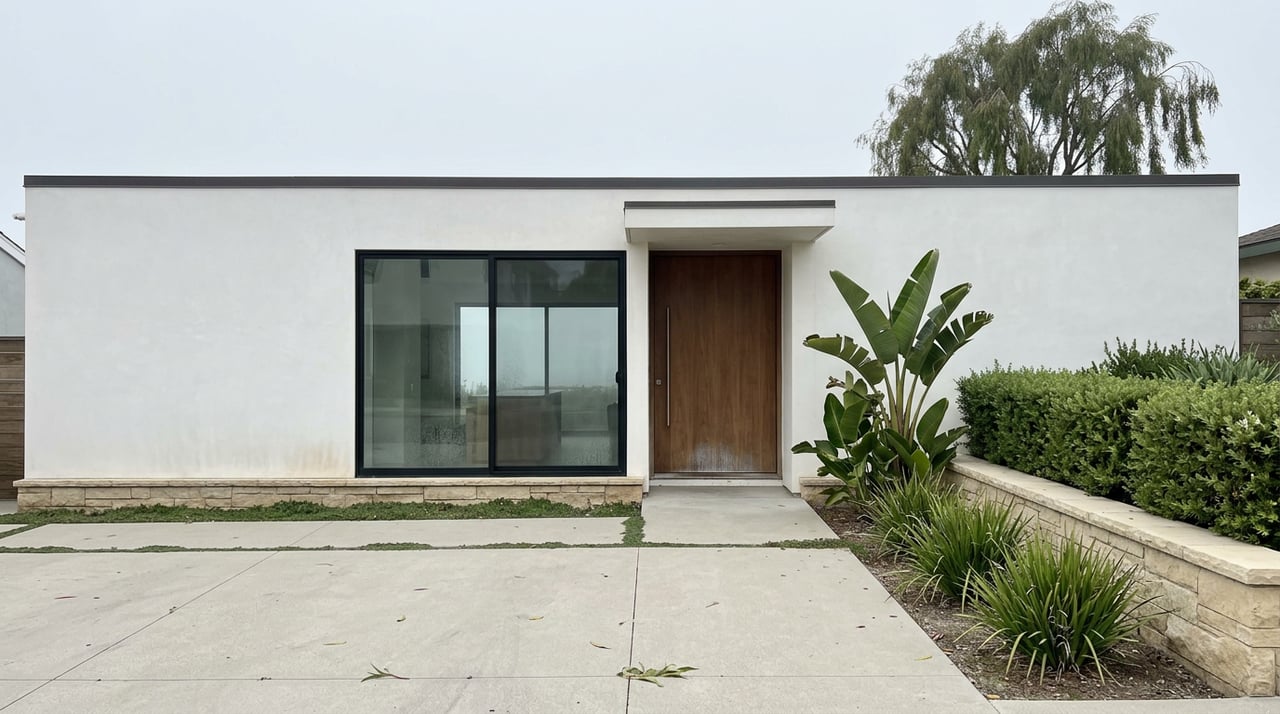
None of this cares what the house looks like. A fully remodeled 1970s ranch three blocks from the pier can sit just inside that 300-foot circle. The nearly identical home two streets over can sit just outside it. One owner adding a room needs an engineer and a work plan, and may need a mitigation system. The other doesn't face that 300-foot trigger. The finish level, the price point, the year built, none of it predicts which side of the line a given parcel falls on. Only the well does.
This is the part that doesn't show up on a walkthrough. A buyer touring two similarly staged, similarly priced homes has no visual way to tell which one carries this obligation. It surfaces in the natural hazard disclosure, the preliminary title report, or a call to the Fire Department, not in the listing photos.
What triggers it, in practice
When a parcel falls inside the 300-foot boundary, the city's own development guide lays out what has to happen before a building or grading permit is issued:
- A methane work plan submitted to the Fire Department before any soil investigation begins
- Soil gas testing to determine whether mitigation is actually required
- If mitigation is required, a gas membrane barrier beneath the slab, and often a venting system with pressure-tested piping
- A parallel soil quality review under Specification 431-92 to check for petroleum-related contamination
The investigation itself can clear a project with no further work required. It just has to happen first. That's the part that catches people off guard during a renovation or a new build: the process, not necessarily the outcome, is what adds time and cost to the permit timeline.
The oceanfront project that shows this at full scale
The clearest recent example of this mechanism playing out is a stretch of coastline between Goldenwest Street and Seapoint Street, land tied to oil production for close to a century as part of the historic Huntington Beach Oil Field. A developer purchased a nearly one-acre oceanfront parcel there from California Resources Corp for $10.3 million in 2024, with plans for ten detached homes designed by Danielian Associates.
Getting there required more than a purchase agreement. The site needed Phase I and Phase II environmental assessments, CalGEM certification that a nearby abandoned well had been properly closed, and methane and soil vapor testing under the city's own specification. Only after clearing those steps did the project secure approval from the California Coastal Commission, one of the more demanding permitting bodies in the state. By mid-2026, that approval had turned a remediated industrial parcel into a shovel-ready residential site.
That sequence, environmental review first, permits second, is the same one a homeowner faces on a much smaller scale when adding a bedroom or pulling a grading permit inside the 300-foot boundary. The oceanfront project just makes the stakes visible.
Where this actually shows up around the city
Huntington Beach's oil field wasn't confined to one corner of town. By October 1921, just a year after the first producing well came in, the field already counted 59 wells along the coastal strip, and by 2000 the city had produced over a billion barrels of oil in total. That kind of footprint doesn't respect the boundaries real estate uses to describe neighborhoods today.
What that means for a buyer comparing pockets of the city: Downtown and Old Town, the coastal stretch through Seacliff, and the strip along PCH toward Bolsa Chica and Sunset Beach all sit closer to where the original field was densest. Newer construction inland, east of Beach Boulevard, is less likely to fall inside a mapped well's 300-foot ring, though the only way to know for certain is to check the specific parcel. Two homes built in the same decade, a mile apart, can land on opposite sides of that boundary simply because of where the historic wells happened to sit.
The geology under Huntington Beach adds a second layer worth understanding alongside this one. The same fault activity that shaped the Huntington Beach Oil Field also produced the sandy, water-saturated coastal soil that puts large parts of the city in mapped liquefaction zones. The two hazards are related in origin but separate in how they're regulated, and a natural hazard disclosure will typically address them as distinct items.
What to actually check before you write an offer
If you're comparing homes in Huntington Beach and want to know where a specific address stands, a few sources answer that faster than guesswork:
The natural hazard disclosure report will flag whether a parcel sits within a mapped methane overlay area. The preliminary title report can surface recorded well locations or environmental notices tied to the property. And a direct call to the Huntington Beach Fire Department, referencing the address, will tell you whether that parcel falls inside an existing well's 300-foot radius under Specification 429.
None of this is a reason to rule a neighborhood out. Plenty of homes inside the boundary clear their soil investigation with no mitigation required at all. It's a reason to ask the question before you're several weeks into escrow and a lender or inspector raises it for you.
A short FAQ
Does this only apply to new construction? No. The 300-foot rule applies to any project that requires a building or grading permit, which includes additions, major remodels, and rebuilds on existing homes, not just ground-up new construction.
Is being inside the boundary a defect I need to disclose as a problem? It's a location circumstance. The city treats it more like a flood zone or a fault line designation: something to understand, price accordingly, and plan around.
Does a neighborhood's reputation tell me whether this applies? No. The 300-foot rule is parcel-specific, not neighborhood-specific. A well's location on a city or CalGEM map determines which addresses are affected, and that map doesn't line up neatly with the names real estate uses to describe different parts of Huntington Beach. The only reliable way to know is to check the address itself.
If you're weighing two Huntington Beach homes that look identical on paper and want to understand what sits underneath one of them before you write an offer, that's exactly the kind of parcel-level question worth asking early. Alondra Guevara can help you pull the right records and read them in context before you're already in escrow.
This article is general information, not legal, tax or financial advice. Consult a qualified professional about your situation.